
Why Do You Refuse So Many Students?
August 2026
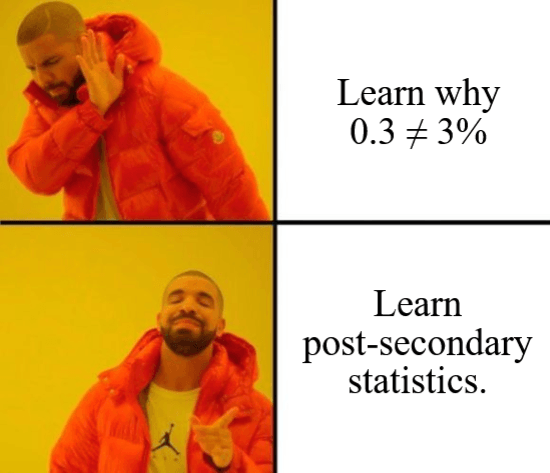
Dear Drake,
I want to help students transform from remedial and demoralized to math stars, from students who cry over their times tables to success as engineers. I want to help students thrive in both math and life.
I understand exactly why you want me to help you cram for your stats quiz on Monday. I'm refusing because your request worsens the underlying problems of prior knowledge and work habits. It paves the way to Math Hell.
Let me know when you want to thrive instead.
Andrew
P.S. For more explanation, see below.
Imagine a fitness client says this to their trainer:
I don't care if I can only bench press 30kg now. I don't care what you think about excessive weights, bad form, or injuries. Maybe other people should slowly raise the load from 30kg to 200kg, but I am a unique individual. Just teach me to bench press 200kg now because I'm trying out for the fire department tomorrow!
Nobody in the world of fitness makes such requests. Any trainer hearing this would fire their client immediately.
So what does this have to do with math? Very little as long as students are 10 or under. If a 9-year-old student can only count as high as 7, there's no point in trying to master 43+18. Everyone knows the student should learn to count no matter what the teacher is doing with the rest of the class. Prerequisites matter.
Well, they matter in reality.
They matter much less in the minds of many people seeking math help. In math education, people, by the millions, reveal their belief that prerequisites don't matter.
There's just something about math that makes people go coocoo for Cocoa Puffs.
Example Precalculus 11 student:
I don't care about equivalent fractions and I don't want to simplify the square root of 12. I don't care what exponents mean. Just show me how to simplify this because I have to pass. I'm NOT going to summer school.
Example Precalculus 12 student:
I don't care if 5÷3 equals 3÷5 or not. I don't care about multiplying or dividing with zero. I don't care about the long-term damage of rote memorizing or cramming. Just show me how to find vertical asymptotes NOW. My quiz is on Monday and I need to maintain a 91% average just to apply to my dream university!*
Whether it's back flipping on skates before standing on skates, lifting 200kg before learning to lift 30kg, or mastering vertical asymptotes before division, these requests are equally irrational. Sadly, this characterizes what many students and parents request as soon as there's an imminent test or deadline. They pave the way to Math Hell.
Yes. Hell. "Hell" is the right word.
Many students memorize and hack their way through tests for years, yielding good grades, but never mastering or understanding anything. For example, hundreds of thousands of community college students don't know that 0.03 and 3% are the same. (The Drake meme was no exaggeration.) In physics, students can solve 2000+ calculation problems and then express that gravity pushes up.
Eventual consequences include
- A lifetime of math phobia
- Not graduating
- Failing
- Mandatory summer school
- Tuition wasted along with other school expenses
- Demoralization, learned helplessness
- Emotional meltdowns
- Inadmissibility to post-secondary programs
- Dropping out of academic programs or school entirely
- Career options closing off
- Financial illiteracy
- Passing math phobia on to their children, etc.
This is Math Hell.
I will not partake.
In some other disciplines, prerequisites matter less strictly. If you've forgotten all about your grade 8 unit on the Roman Empire, you can still learn about Italy’s role in World War II in grade 9. Many students can get away with learning little in English 10 and 11, but if they apply themselves in English 12, they can get the marks they need for university. Buckling down now to improve learning and marks now works in many cases.
But not in math.
In math, you must learn that 0.3 is not 3% before you can begin learning post-secondary statistics.
A student who caught a cold in grade 4 during the division unit must either remediate that foundation or suffer with math forever. They'll likely fail to grasp its inverse relationship with multiplication, fractions as division, ratios and rates as division, etc. They'll confuse 5÷3 and 3÷5. But they can fake mastery on assessments (that are too easy) by memorizing and cramming, getting marks that are too high, reinforcing the idea that shortcuts in math work.
Then when they face conceptual questions about vertical asymptotes, they're trying to build on years of missing foundations. There is no way to master the content by Monday's quiz. Working hard all weekend might improve one's marks from 22% to 24%.
I feel bad for students and parents in these positions. I feel especially bad for those who can't even tell they are insisting on harmful cramming. It is painful to hear and hard to believe that hard work won't be enough to save the next report card, that months of remediation is the only route to mastery, that marks will fall along that route, that the marks received in the past drastically overestimated their learning.
But I've also learned that it is easier to talk a hungry dog off a meat truck than to talk people off the path to Math Hell.
I don't refuse students because they're behind. I refuse to help them pretend that cramming won’t leave them farther behind.
And there are other students and families that I can actually help.
That's why I refuse so many students.
Notes
* Depressingly, parents, teachers, counselors, administrators, post-secondary admission consultants, etc. often support this approach to “learning”.