
Counting to Calculus
Dear Learners,
Welcome to Counting to Calculus, a course with one revolutionary aim: To guide you from counting to calculus in 80 lessons.*
That means you might be doing grade 5 math now. But with 2 lessons per week plus daily homework, you can start doing university-level math within a year.
You'll need to try really hard. That means showing up, paying attention, persevering, studying on your own, and testing yourself a lot. A. Lot. You may even have to go back to review things from scratch that you thought you learned earlier. You might have to reverse some bad habits and limiting beliefs. It wont always be fun. But it can always lead to growth and fulfillment.
In turn, we intend to leave you thrilled with your progress, mathematically ready for any career, college, or university, and ready to learn anything. You can be years ahead of your peers and astonished with your own brilliance. If we do things right, this can revolutionize your life. Heck, you might even get a job with us.
As of Oct 2026 it remains very crude, but will receive updates weekly until that revolution is complete. As you go through the course, you will like some things more than others, you'll find some things easy and some hard. Please share feedback by email to andrew@bravomath.com.
Are you as excited as I am?
Let's go!
Andrew
*Bravo Math is nowhere near that 80 number now (Oct 2026), but with your help and feedback, we will get there.
Dear Educators,
Counting to Calculus aims to empower any educator to guide any learner from counting to calculus in 80 lessons.* If you're motivated to become a vastly better educator, this course should be the epiphany you need to become one.
Counting to calculus in 80 lessons may sound impossible, but this is not fancy pie-in-the-sky thinking. It rests on testable but revolutionary hypotheses that combine knowledge dependencies, pedagogical progress through cognitive science and design, and years of my own craft knowledge. This can happen and I am going to prove it.
As of Oct 2026, the course is very crude. I am releasing all content early for the sake of rapid iteration and early feedback.
If you'd like to join the founding team, please apply.
Share any comments or feedback by email to andrew@bravomath.com.
Andrew
*Bravo Math is nowhere near that 80 number now (Oct 2026), but with your help and feedback, we will get there.
The Learner's Journey from Counting to Calculus
Version 1 (Oct 2026)
Coming soon
Version 2 (date TBD)
Coming soon
Course Rules
- Course Entry Screening. All new students do a math diagnostic and discuss with us what they want to learn and why. Most people just want to get good enough marks and do not care at all about learning. One day Bravo Math will be able to help those students, but that day is not today. Students who qualify for C2C will be placed into the lowest level course that they haven't mastered. If a 32-year-old adult ed student does 15 minus 9 on their fingers, that is where we start. Period.
- Students must attend two 1-hour lessons per week. They must arrive on time and prepared to learn. They must be respectful to everyone in the community. The teacher is responsible for teaching what that all means. Violating the rules can result in immediate suspension or expulsion without warning. Bravo Math will one day be able to help less mature students, but that day is also not today.
- Students must do daily homework, not merely to the point of completion, but to the point of mastery. They should be ready to nail any pop quiz on any content they have ever covered with us. And there will be many (diagnostic) quizzes.
- Each course will follow the same 6-week schedule. The shortness improves feedback loops for everyone. Students do not need to dread repeating a course or waiting a year to rewrite a test. And Bravo Math will get better feedback and iterate its pedagogy seven times faster than a typical year-long math course.
- Week 1: Sessions 1 and 2, lessons
- Week 2: Sessions 3 and 4, lessons
- Week 3: Sessions 5 and 6, lessons
- Week 4: Sessions 7 and 8, lessons
- Week 5: Session 9, lesson. Session 10, Transition Test, Attempt 1 (see below)
- Week 6: Session 11, feedback on Attempt 1. Session 12, is either Attempt 2 for those who didn't pass the first time or an honours challenge assignment for those who did.
- Bravo Math has a particular testing routine, all in an attempt to align incentives and seek truth in terms of student learning.
- Though Bravo Math does testing internally now, we seek *external* testing. At a minimum, the instructor of the next course should create and mark the tests from the previous course, and use that to decide who gets in. We consider the teacher making and marking their own summatives to be a critical conflict of interest in education.
- We normalize taking two attempts, which eliminates penalties for early struggles while rewarding learning from experience.
- A transition test is the sole criterion for both certifying completion of one course and for entry into the next course. Each test is marked as either "Mastered" in which case the student will receive certification and move on or "Try Again" in which case the student must retake the course and/or rewrite the test at the next available time. If the student tried their hardest and did not pass, there is no charge for second or third attempts as Bravo Math takes pedagogical responsibility for this. And don't worry if you get a "Try Again" - the course is only 6 weeks long and the next testing oppourtunity is just 6 weeks away. :-)
- To help counter grade inflation, "Mastered" must mean mastery. That means both the student and the teacher must predict, in probabilistic terms, how well the student will do in the next course as well as a justification for that prediction.
- Each test will have two or three sections. The first section, which will not always be present, is "Cumulative" covering any content from any previous course. The second is "Automaticity" which covers routine exercises and basic reasoning. It is strictly time-limited. The third is a non-routine task, such as teaching the content, a twist on routine exercises, a more complex application, etc.
Rules for Learning
- Get the incentives and inspiration right.
- Create an environment for success. Gather key belongings and motivators. Eliminate all distractions.
- Grow Your Brain!
- Spend most of your time on tasks barely beyond what you've already mastered... Even if that's not what you're doing in school.
- Focus intensely to trigger neuroplasticity.
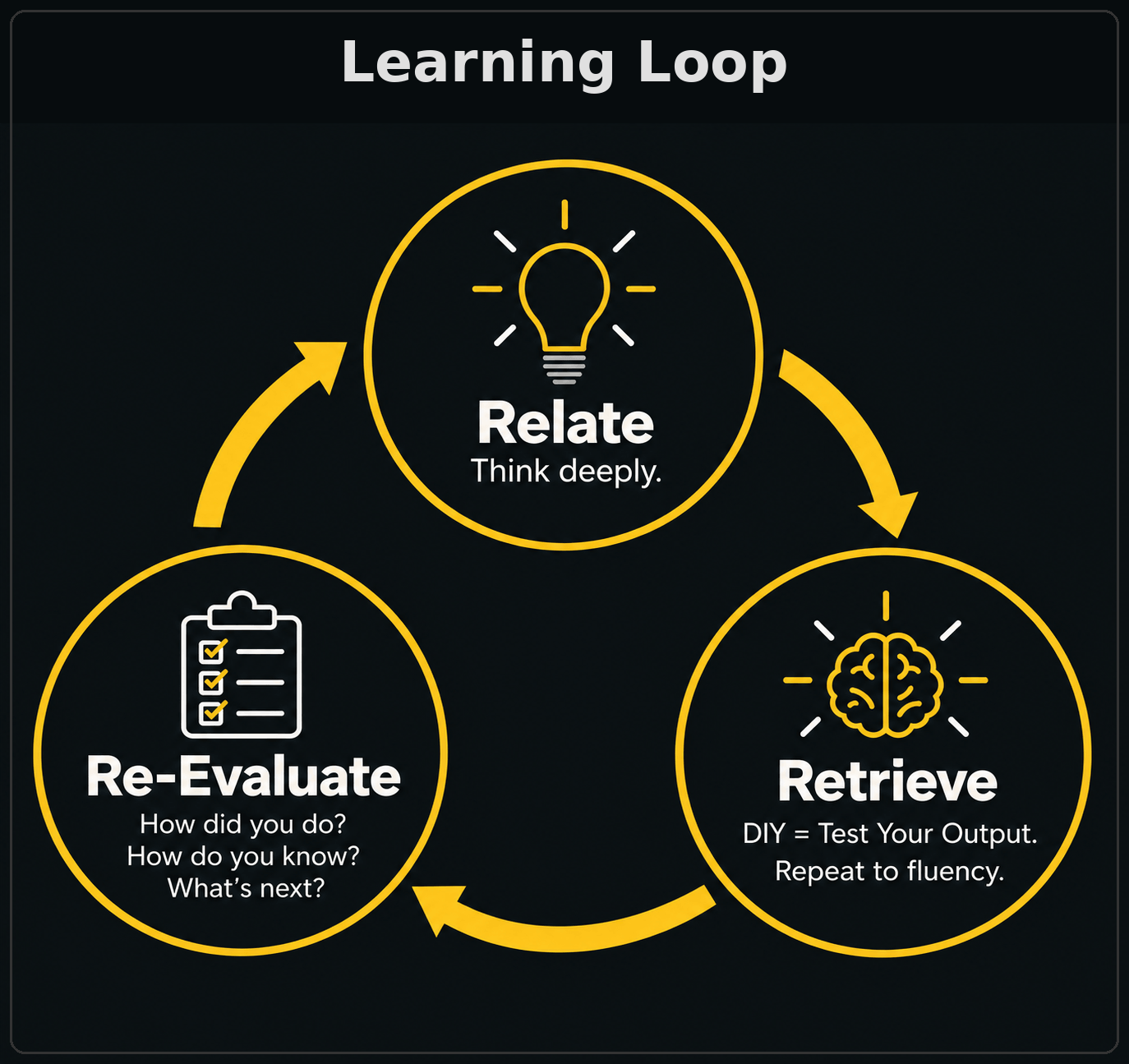
- Cycle through the learning loop.
Course Content
Counting to Calculus (C2C) covers only "bottleneck content" to bridge those two points in a student's math journey. See Hypothesis 1.
| Course | Description |
|---|---|
| Integers 1: How Many? | Counting forwards and backwards from 0 to 100, Not a priority as of Sept 2026. |
| Integers 2: Add & Subtract within 100 | Problem structures, math facts, and mental math. |
| Integers 3: Multiply & Divide within 100 | Problem structures, math facts, and mental math. |
| Integers 4: All Operations within 100 | Multi-step problem structures and mental math. |
| Integers 5: Place Value | Scaling Integers 1-4 by factors of 10 (e.g. Relating 9+7 to 900 million plus 700 million). |
| Integers 6: Negativity | Extending the above to negative integers. |
| Fractions 1: Fractions are Numbers | Counting, representing, and comparing fractions, all in relation to whole numbers. |
| Fractions 2: Whole & Fraction Arithmetic | Problem structures and mental math. |
| Fractions 3: Fraction & Fraction Arithmetic | Problem structures and mental math. |
| Fractions 4: Rational Numbers | Extending Fractions 1-3 to decimals, percents, ratios, rates, proportions, and negatives. |
| Algebra 1: Solutions & Equality | Solutions, Solving, and Preservation of Equality. |
| Algebra 2: Recursion & Linear Relations | Generality and predictiveness of algebra. Rate of change. Representing relations with tables, graphs, equations, diagrams, stories, etc. |
| Algebra 3: Functions | Extending Algebra 1 & 2 to quadratic and exponential relations. |
| Calculus | Rate of change vs rate of accumulation, Fundamental Theorem of Calculus. |
| Statistics | Probability distribution functions, causal inference. |
Math Resources
Calculators and Software
- Desmos Graphing Calculator
- Desmos Scientific Calculator
- Symbolab
- Wolfram Alpha
- Casio FX-991ESPLUS2— Excellent, user-friendly, and affordable.
Math Paper & Templates
These have two pages of each paper type, so print double-sided to save trees!
- Variety of Grid Paper
- 1 cm Grid Paper
- 1 cm Dot Paper
- Isometric Dot Paper
- Frayer Models — A framework for studying individual words.
- How to learn from examples
- Landscape Learn from Examples Template
- Portrait Learn from Examples Template
Homework
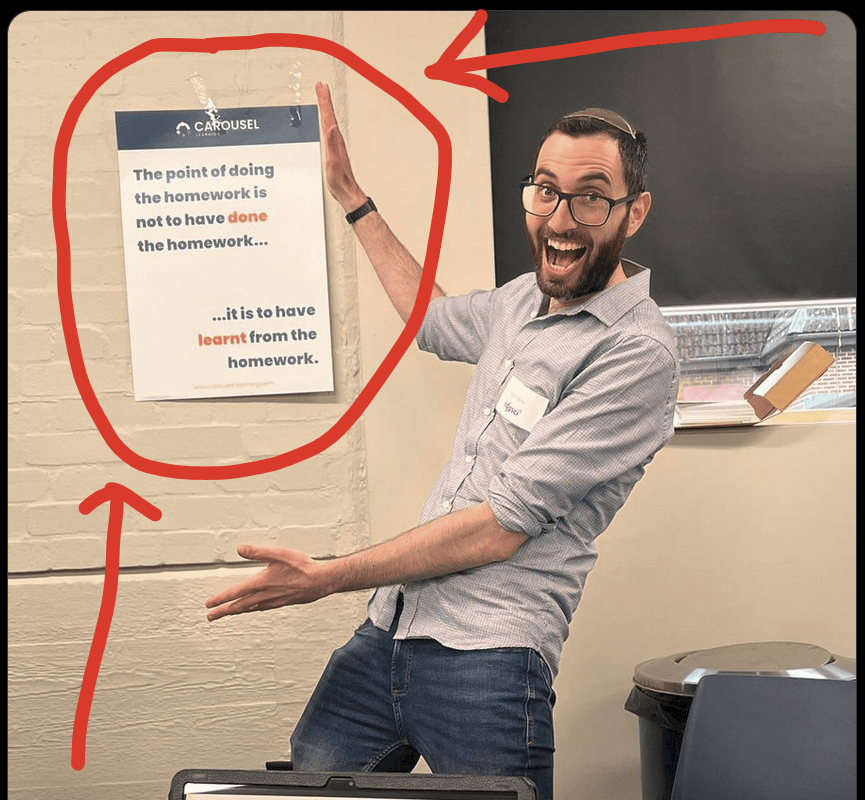
You Can Learn Math – Mindset
Four Key Messages
Discussion Question: Many "growth mindset" interventions in schools have been disappointing. Read this article and write down your thoughts.
Assessments
🚧 This course is currently under development.
Bravo Math is not currently accepting students who are still learning how to count, so this course is not a high priority at the moment. It will continue to grow over time as new lessons, activities, games, and resources are added.
Course Resources
Interactive Tools
Even & Odd Numbers
I will solve the 6 Loonies Problem . (Source: Mindtrap's "Geometrical Riddles")
Tens & Ones
Activity 1
Put 1 cm-based tens and ones blocks in a bag. Without looking, determine how many there are just by feel. Then check your answer using the 1 cm Square Hundreds Chart .
Activity 2
Play Four in a Row Tic-Tac-Toe on a 10×10 grid (a hundreds chart without the numerals).
Activity 3
Pick a Number.
Whole Course Resources
In this course, students will master addition and subtraction of whole numbers within 100, from meaning to mental math, from pictures and manipulatives to equations and word problems. Confidence should soar and a very strong foundation will be laid for multiplication, division, and all future math.
Essential Questions
- How do addition and subtraction improve upon counting?
- How do addition and subtraction help us solve problems?
- How are addition and subtraction related?
- How can we use concrete objects, pictures, words, and symbols to represent our thinking? What are the pros and cons of each?
- What is the purpose of automatic recall? Which facts (equations) are worth learning to this level of mastery and which are not?
Whole Course Resources
Games & Puzzles
- Tic-Tac-Toe Sums
- Fifteen – player vs. computer
- Fifteen – player vs. player. Materials: Ace through 9 of one suit or any other indicators of 1 through 9.
- Enclosure (Click Level 1a, 1b, or 2 on the left panel, then press the green Recompile button.)
- Black Hole
- Number Track Game (Click on 0_to_100 on the left panel then recompile.)
- KenKen Puzzles
-
Knock Out
- Games for Young Minds explanation
- YouTube video
- Game board printout [coming soon]
- Number Hives
Content Sequence
- 1.1–1.3 You will learn about the basic Problems and Models of addition and subtraction. You'll learn how to express your ideas in terms of objects, number tracks and bars, ten frames, base ten blocks, math words, and math symbols.
- 2.1–2.6 You will sharpen your mental addition including automatic recall for all facts within 20 and fluency for all addition within 100.
- 3.1–3.3 You will first relate subtraction to addition. You will sharpen your mental subtraction including automatic recall for all facts within 20 and fluency for all subtraction within 100.
- 4.1–4.2 You will put it all together, learning to represent and solve all types of problems and equations within 100.
1.1 Parts, Wholes & Changes
I will...
- Master discrete models of parts, wholes, and changes.
-
Master linear models of parts, wholes, and changes.
- Number Tracks
- From Counters to Bar Models
- Linear Representations of Parts, Wholes, and Changes within 20
- Parts & Wholes with Xs and Os
-
Play games.
- Auction 35. Best played with 35 counters and a deck of cards, but if online, use the Auction 35 Gameboard Printout .
- Nim
- Crash! (aka Pig). Can be played with pencil and paper, but beginners should use the Crash gameboard .
- Jack and Jill's Pails [source: Mindtrap's Geometrical Riddles]
- Solve real-life problems with addition and subtraction. [Coming soon.]
So I can...
- Solve all types of parts, wholes, and change word problems.
- Represent my thinking with manipulatives (linear and discrete), words, pictures, and counting.
As assessed now by...
- My ability to create, represent, and solve a variety of practical problems. Detailed instructions & rubric .
- (Mandatory for adult learners, optional for younger learners) Parse every addition and subtraction situation using mathematical vocabulary.
As assessed in the future by...
- My ability to build on this knowledge in Lesson 2 (Equations and Calculation) and Lesson 3 (comparisons).
- My ability to instantly recognize whether to add, subtract, or do neither in the future.
1.2 Comparisons
I will...
- Practice on this comparison template .
- [more coming soon]
So I can...
Compare any whole numbers between 0 and 100 using manipulatives, discrete or linear pictures, words, and counting.
As assessed by...
- [coming soon]
1.3 Equations & Calculations
I will...
- [coming soon]
So I can...
- Do everything from Lesson 3 and...
- Recognize and explain when to add versus when to subtract. I can generate examples to aid my explanations.
I will...
-
Practice solving problems, modeling them with bars, and describing them with fact families.
- Fact Families [under construction]
- Add & Subtract Fact Families & Bar Diagrams
- Do equation drills for fact families.
As assessed by...
- [coming soon]
2.1 Basic Addition Facts
I will...
- Play KenKen . Focus on the + and -, obviously! How big of a square can you beat? And at what level of difficulty?
- Play Black Hole .
- Play Tic-Tac-Toe Sums.
-
Master decomposition by playing Knockout. Suggestion: start with two 6-sided dice, then two 8- or 10-sided dice.
- Games for Young Minds explanation
- YouTube video
- Game board printout [coming soon]
-
Master the Doubles by
- Playing The 5 by 5 Game . Gameboard Printout
- Drilling Doubles, Jumbled, All and Doubles, Jumbled, Mostly Harder [coming soon].
-
Master the Parts of 10 by
- Doing Greg Tang's "The Tens"
- Playing Squirmy Wormy
- Drilling Partners to 10
- Drill Ten Plus equations .
-
Do Rocket Math drills. [Ask Andrew for links to the files.]
- Instructions / Administration
- Addition Diagnostic & Drills
- Addition Answers
- Subtraction Diagnostic & Drills
- Subtraction Answers
- Practice Incremental Addition Facts .
So I can...
Demonstrate automatic recall of
- The parts of 5, 6, and 10 (e.g. 3+___=10)
- Addition of 0, 1, 2, and 10 (e.g. 3+10=___)
- All doubles facts (e.g. 8+8=___)
Where "automatic recall" means that correct answers pop into your mind instantly and with no effort. Such recall is easier, more accurate, and faster than counting or modeling.
As assessed by...
[Coming soon]
2.2 Basic Addition Facts Plus or Minus 1 or 2
I will...
- Use Amplify Fluency .
- Practice Making Tens .
- Equation Drills for Ten
-
Adjusting Basic Facts Template
Use for
- Doubles +1 and +2
- Variants on Partners to 10
- Making tens.
-
Equation Drills for Doubles
- Doubles + or - 1, Simple
- Doubles, + or - 1, Jumbled
- Doubles, Sometimes + or - 1, Simple
- Doubles, Sometimes + or - 1, Jumbled
- Doubles, + or - 2, Simple
- Doubles, + or - 2, Jumbled
- Doubles, Sometimes + or - 2, Simple
- Doubles, Sometimes + or - 2, Jumbled [coming soon]
- All kinds of doubles and variants
- Practice Incremental Addition Facts .
So I can...
Demonstrate automatic recall of all basic facts, plus or minus 1, including
- Doubles Plus or Minus 1 (e.g. 8+7=___)
- Doubles Plus or Minus 2 (e.g. 8+6=___)
- Making 10 with 8 or 9 (e.g. 9+6=___)
- Partners to 9 and 11 (e.g. ___+6=11 or ___+3=9)
As assessed by...
- [coming soon]
2.3 Extending Single-Digit Addition Facts to 20
I will...
- Drill equations to fluency.
- Make a Magic Square from 1 to 9 .
So I can...
Demonstrate automatic recall of all addition facts within 20.
As assessed by...
- [coming soon]
2.4 Extending Single-Digit Addition Facts to 100
I will...
-
Learn "Don't Cross 10"
- Concept & Visual Work
- Fluency Practice
-
Learn "Cross 10"
- Concept & Visual Work
- Fluency Practice
-
Learn "Move Over"
- Concept & Visual Work
- Fluency Practice
- Put it all together.
- Drill
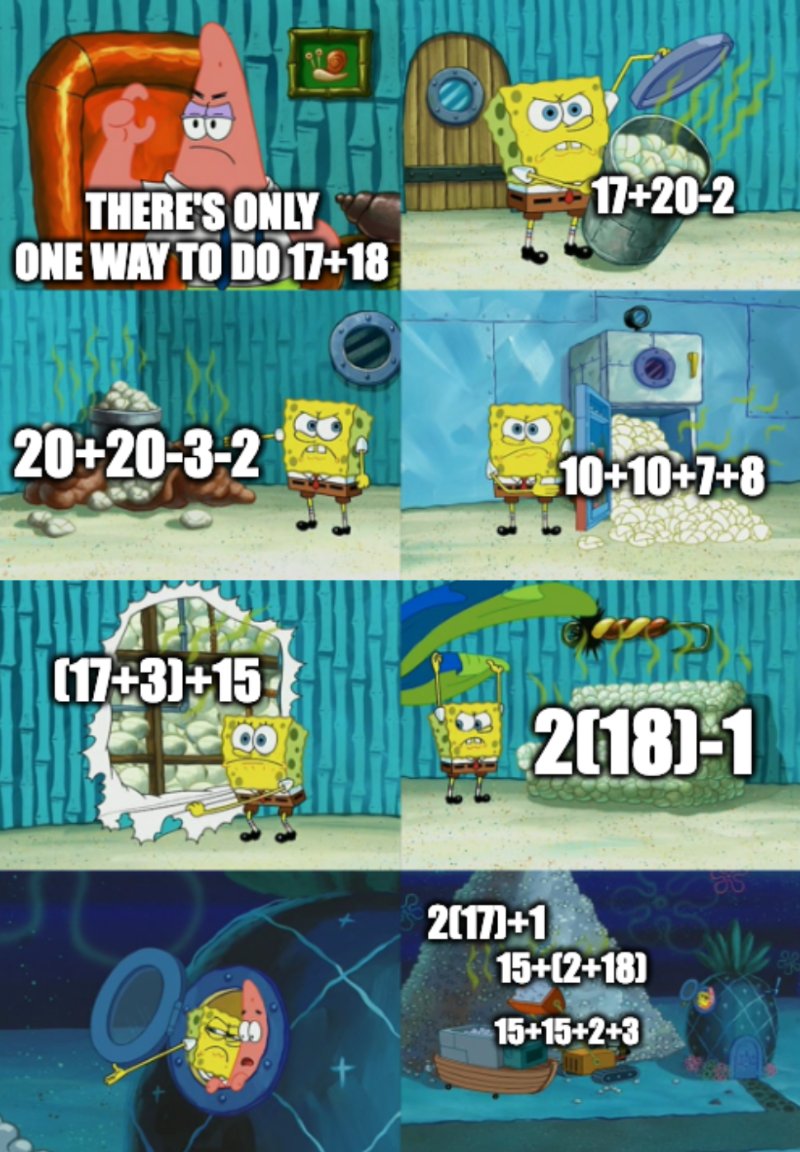
- Extend Counting Up or Adjusting .
- Practice demonstrating my thinking in a variety of ways, including equations.
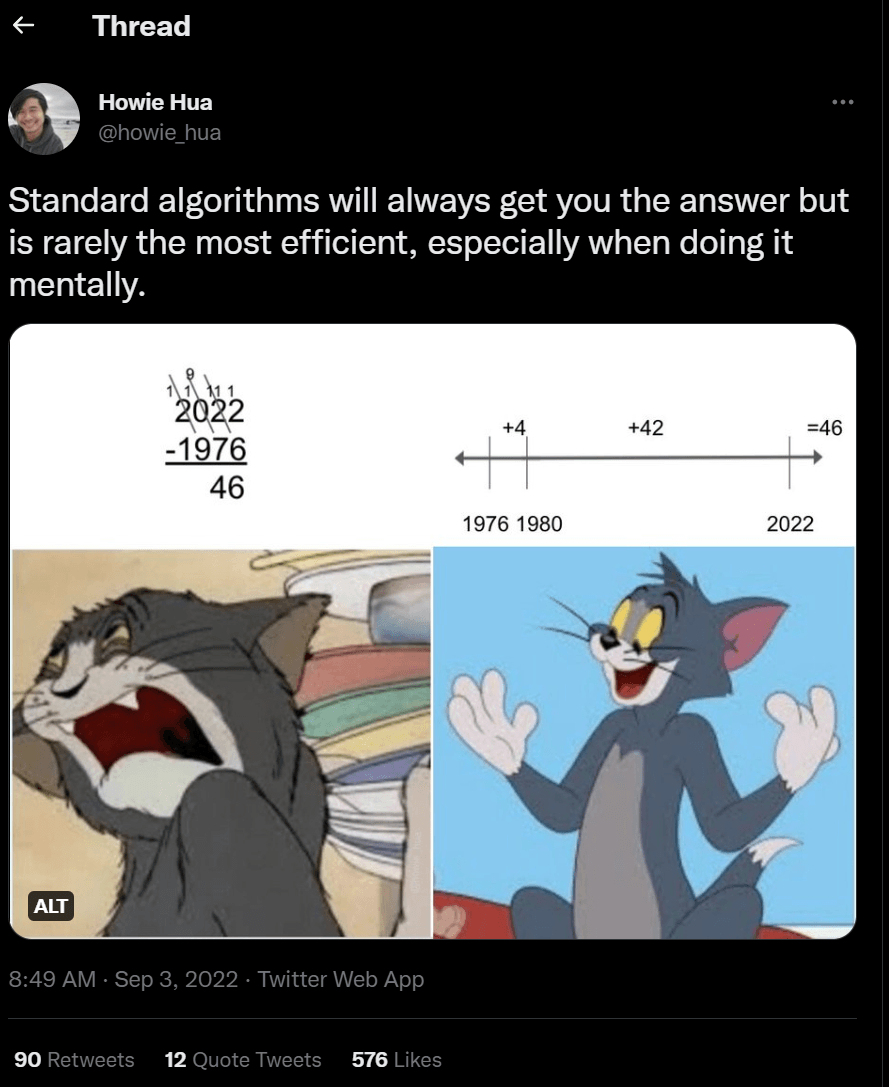
Source:
Howie Hua's Twitter thread
So I can...
- Extend all previous mental math strategies to 100. Discuss and demonstrate such extensions in a variety of ways.
- Demonstrate fluency in the strategy of dealing with tens and ones separately.
As assessed by...
- [coming soon]
2.5 Addition Within 100 - Multiples of 10 (and + or - 1 or 2)
I will...
- Reverse engineer, explain, and perform the "Pick a Number" card trick.
- Play Number Grid Tic-Tac-Toe .
- Play Tic-Tac-Toe Sums (using the "Multiples of 10" version).
- Solve and analyze the Magic Triangle .
- Make a bunch of mental math webs.
- Drill Adding Multiples of 10
- Partners to Multiples of 10
So I can...
- Add and subtract multiples of ten fluently, by relating them to single-digit addition facts.
- Determine parts of multiples of ten by comparing them to easier equations and/or counting up.
As assessed by...
- [coming soon]
2.6 Addition Within 100
3.1 Solving Addition Equations
3.2 Basic Subtraction Facts within 20
Basic Subtraction Facts Diagnostic & Exit Assessment
3.3 Intermediate Subtraction Facts within 20
Intermediate Subtraction Facts, Part 1 - The Last Ones
Intermediate Subtraction Facts, Part 2 - Ten More
3.4 Advanced Subtraction Facts within 20
Advanced Subtraction Facts, Concept Development
Advanced Subtraction Facts, Fluency Practice
3.5 Subtraction within 100
4.1 Addition & Subtraction within 100
So I can...
- Demonstrate automatic recall of all addition and subtraction facts within 20, in all forms. If writing speed is a problem, you may have someone else write for you while you state solutions aloud.
4.2 Putting it All Together
I will...
- [coming soon]
So I can...
- Demonstrate either fluency and flexibility with strategies and/or automatic recall for all addition and subtraction within 100.
- Apply the above in pure and applied math contexts.
- Do all of the above without guessing, counting, or modeling.
- Prove my work is right or wrong in a variety of ways.
- Succeed at rich math problems and mini numeracy tasks by myself.
As assessed by...
- [coming soon]
Whole Course Resources
In this course, students will master multiplication and division within 100. They will develop deep conceptual understanding through equal groups, arrays, number tracks, equations, and real-world problems before building fluency with multiplication and division facts.
Essential Questions
- How do multiplication and division and multiplication help us solve problems? What types of problems?
- How can we represent our thinking about multiplication and division?
- How are multiplication, division, addition, and subtraction all related? How do we know when to use each?
- How can we use one multiplication fact to determine another?
- How can we use one division fact to determine another?
- Which multiplication and division facts should be memorized? And when is it OK or better to estimate or use a strategy or a calculator?
Whole Course Resources
Lesson 1: Equal Groups (Sets)
I will...
- Do the Introduction to Equal Groups .
- Play The Pizza Game and variations on it.
- Do leveled picture drills for Equal Sets.
- Do JUMP Division Worksheets - Visuals .
So I can...
- Translate fluently between manipulatives, pictures, and stories.
- Parse and describe equal grouping situations in terms of number of groups, amount per group, and total.
As assessed by...
[Coming soon]
Lesson 2: Equal Rows
I will...
-
Play area games!
-
How Close to 100?
- YouCubed instructions
- Normal gameboard
- Create variations on your own grid paper .
-
Area Battle [How Many Rows? How Many in Each Row?]
- YouCubed instructions
- Gameboard printout
- Create variations on your own grid paper .
-
How Close to 100?
- Solve problems with areas & arrays. [Under construction]
So I can...
- Translate fluently between manipulatives, pictures, and stories.
- Parse and describe equal row situations in terms of number of rows, amount per row, and total.
As assessed by...
[Coming soon]
Lesson 3: Equal Jumps
I will...
- Model equal jump problems on a number track [Select document B in the left panel then press "Recompile"].
So I can...
- Translate fluently between manipulatives, pictures, and stories.
- Parse and describe equal jump situations in terms of number of steps, amount per step, and total.
As assessed by...
[coming soon]
Lesson 4: Groups, Rows, Jumps, and Commutativity
I will...
[coming soon]
So I can...
- Translate fluently between all visual representations of equal sets.
- Generate and describe examples of how they correspond.
- Show commutativity in all groups, rows, and arrays.
As assessed by...
[coming soon]
Cumulative Checkpoint 1
[coming soon]
Objective 3.9 Remainders
I will...
- Play the Factor Game .
- Play Last to Zero .
- Do leveled drills for remainders.
- Drill solving and representing remainders in groups, rows, and jump situations. [Under construction.]
- Do JUMP Mult & Div Review, with Remainders.
- Learn to use the words "multiple" and "factor" and how they relate to remainders and divisibility. I'll be able to describe all the divisibility rules and create examples to show them.
So I can...
- Explain and demonstrate with my own examples when and why remainders occur, what they are, and how to interpret them in context for all previous representation.
- Explain my reasoning using the words "multiple" and "factor".
- Use equations to record my thinking about remainders.
As assessed by...
- 2.9.2 Students will be fluent in solving division equations with and without remainders (15 solutions per minute, 95% accuracy, can do orally as teacher or tutor writes). Remainder Drills - Division Only
-
2.9.3 Students will be fluent in evaluating division expressions sometimes involving remainders and determining a corresponding multiplication or division statement.
Remainder Drills - Mult & Div
.
Example:
7÷2=3 R1 ⟺ 2×3+1=7 - 2.9.4 Students will be able to generate examples of all of the above.
Lesson 6: Equations
I will...
-
Do leveled drills on equations.
- Master fact families for multiplication and division.
- Level 4b - Write Equations
- Representing Multiplication & Division Template
- Practice Three Methods to Divide (this is just a template now; exercises coming later).
- All Structures Word Problems (except ratios and rates).
So I can...
- Translate fluently between previous representations, repeated addition and repeated subtraction equations, and multiplication and division equations.
- Recognize and explain when to multiply and when to divide.
- Show and explain the relationship between all operations.
As assessed by...
[coming soon]
Lesson 7: Counting by 2, 5, and 10
I will...
-
Skip Counting
- Scorecard
- Drill pages
- Mr DeMaio's Multiplication Songs (actually skip counting).
- Tic-Tac-Toe Products
So I can...
- Count by 2, 5, and 10 up to 10 groups, without reference to ones. I use automatic recall or addition strategies instead.
- Show my thinking with manipulatives, number tracks and/or number lines, aloud, and in written sequences and tables.
- Use skip counting to solve equations and I always pick the easier skip count when possible.
As assessed by...
[coming soon]
Lesson 8: Counting by 3, 4, and 9 [ongoing]
I will...
- Mr DeMaio's Multiplication Songs (actually skip counting).
- Figure out Which Number Doesn't Belong [source: Mindtrap's "Geometrical Riddles"].
So I can...
- Count fluently by 3, 4, and 9 up to 10 groups, without reference to ones. I use automatic recall or addition strategies instead.
- Show my thinking with manipulatives, number tracks and/or number lines, aloud, and in written sequences and tables.
- Use skip counting to solve equations and I always pick the easier skip count when possible.
As assessed by...
[coming soon]
Lesson 9: Counting by 6, 7, and 8 [ongoing]
I will...
- Mr DeMaio's Multiplication Songs (actually skip counting).
So I can...
- Count fluently by 6, 7, and 8, up to 10 groups, without reference to ones. I use automatic recall or addition strategies instead.
- Show my thinking with manipulatives, number tracks and/or number lines, aloud, and in written sequences and tables.
- Use skip counting to solve equations and I always pick the easier skip count when possible.
As assessed by...
[coming soon]
Cumulative Checkpoint 2
Lesson 10: Beginner Times Tables [ongoing]
I will...
- Print the Times Tables and track my progress on it.
- Practice Incremental Multiplication Facts (will have to create a new copy for each student).
- Learn the patterns of the 6 and 9 times table, then drill them.
- Play!
-
Do progressive fact drills.
- Zak Facts
- Rocket Math [uploaded to Bravo Math servers, not Google Drive]
So I can...
- I can demonstrate automatic recall for the 0, 1, 2, and 10 times tables.
- I can demonstrate fluency in multiplying by 10 then dividing by 2 and/or using recall for the 5 times table.
- I can apply the distributive property for the 9, 6, and 3 times tables. I can represent my thinking in a variety of ways.
As assessed by...
[coming soon]
Lesson 11: Intermediate Times Tables, 60 and 100 [ongoing]
I will...
- Play Meteor Multiplication .
- Drill the Factors of 100 .
- Learn the Factors of 60.
- Practice Incremental Multiplication Facts .
I can...
- Use repeated doubling strategies for the 4 and 8 times table.
- Demonstrate automatic recall, fluency in strategies and/or mnemonics, for all remaining times table facts.
- Demonstrate automatic recall for all factor pairs of 60 and 100.
As assessed by...
[coming soon]
Lesson 12: Advanced Times Tables [ongoing]
I will...
- Play Meteor Multiplication .
-
Play variations on Tic-Tac-Toe.
- Tic Tac Toe Products
- The Product Game
- Do × & ÷ Fact Drills.
- Distributive Property Drills .
- Practice Incremental Multiplication Facts .
So I can...
- Demonstrate such fluency in all of the previous strategies and/or have such automatic recall for all times table facts that looking up answers, drawing, guessing, or counting all slow me down.
- Demonstrate flexibility and fluency in using strategies to multiply and divide within 100. I can record my thinking with equations and diagrams.
- Apply my skills in context and create a visual if necessary.
As assessed by...
[coming soon]
Lesson 13: Comparisons
I will...
[coming soon]
So I can...
- I can translate fluently between direct models (linear and discrete), pictures, words, and counting.
- I can compare quantities using subtraction and division, record my thinking with equations, and interpret appropriately in context.
As assessed by...
[coming soon]
Lesson 14: Ratios, Rates, and Proportions
I will...
[under construction]
- Craig Barton-recommended ratios/proportion thing , N6
- Desmos: Balloon Float
- Desmos: Pizza Toppings
- Thinking in Rates
- Multiply or Divide? All Structures
I can...
- Use multiplication and division to solve simple applications involving ratios and rates.
- Succeed at rich problems and mini numeracy tasks by myself.
As assessed by...
[coming soon]
Exit Assessment
Whole Course Resources
Essential Questions
- What are the relationships between the four operations (add, subtract, multiply, divide)?
- How does one decide which operation is most useful?
- How should one represent their thinking?
Whole Course Resources
Mental Math: Basic
Mental Math: Intermediate
Mental Math: Advanced
Comparison Symbols
Commutativity, Associativity, & Multi-Step Equations
https://twitter.com/jemmaths/status/1471835427158040579
Putting it All Together - Basic
-
Draw & Select Operations
-
How do you
Make 6
?
[source: Mindtrap's "Geometrical Riddles"]
- Hint: The answer key has 3 solutions... but you might be able to think of more if you use brackets!
- Make your own variations of this puzzle!
- The Clock Split Problem
-
How do you
Make 6
?
[source: Mindtrap's "Geometrical Riddles"]
Putting it All Together - Intermediate
Putting it All Together - Advanced
Exit Assessment
General
Whole Course Resources
Base Numbers - Basic
Binary Code Links
Base Numbers - Intermediate
Universal Livestock Tablet
Base Numbers - Advanced
Base 10: Flexibility & Representations - Basic
Base 10: Flexibility & Representations - Intermediate
Base 10: Flexibility & Representations - Advanced
Add & Subtract - Basic
-
Adding by Regrouping Tens
- Spintegers
-
Add & Subtract - Intermediate
Multiply & Divide - Basic
- Game: Multiplication Spinners!
Multiply & Divide - Intermediate
-
Scaling Multiplication and Division Facts
- Scaled Up × Facts
- Scaled Up ÷ Facts
- Scaled × & ÷ Facts, Simple [under construction]
- Scaled × & ÷ Facts, Jumbled [under construction]
- Multiply 2-digit by 1-digit Numbers
Multiply & Divide - Advanced
- Spintegers
All Operations - Basic
All Operations - Intermediate
I will...
- Find a solution to the Three Numbers Puzzle .
All Operations - Advanced
Course Outline
Essential Questions
- Why did mathematicians invent negative numbers? How are negative numbers used in the real world?
- How is arithmetic with negative numbers similar to arithmetic with positive numbers? How is it different?
Resources
- Negative Integers Diagnostic
- Enclosure . Documents 3, 4, and 5 in the left panel are relevant.
- Number Lines: -50 to 50 & -100 to 0
- Number Tracks (click on the files that start with "neg" on the left panel, then click "Recompile".)
- Number Hives
Lesson 1: Count & Compare
I will...
- Analyze Temperature Changes.
- Play Crash!
- Play Target! Number Tracks are the game board. Go to document (C) in the left-panel then press the recompile button. To make the board in a big line, you'll need to print the papers and cut them into strip with scissors. You will need a deck of cards and two tokens of different colors.
-
Apply my knowledge of counting and comparing to negative integers in
Integer Notation Made Explicit
- Temperatures and Thermometers
- Banks and Balances
- [more coming soon.]
- Compare integers using number lines and inequalities in JUMP Compare Integers .
So I can...
- Extend my understanding of counting and comparing numbers to negative integers.
As assessed by...
[coming soon]
Lesson 2: Add & Subtract
I will...
-
Play
- Enclosure . Documents 3, 4, and 5 in the left panel are relevant.
- The Number Track game. Game board (click on "-50 to 50" in the left panel then press "recompile"). Rules .
- Play Auction 35!
-
Do leveled integers drills.
- Level 1a: Add & Subtract, Describe the Vector
- Level 1b: Add & Subtract, Draw the Vector to Answer
- Level 1c: Add & Subtract, Draw the Vector to Answer, Jumbled
- Level 2a: Signs Only
- Level 2b: Picture Mentally, Magnitudes within 20
- Level 2c: Picture Mentally, Magnitudes within 20 - Jumbled
- Level 2d: Picture Mentally, Varied Magnitudes
- JUMP Gains and Losses
-

- Represent my thinking from the last unit using equations. [More details coming soon.]
So I can...
- Demonstrate my understanding of adding and subtracting below zero through number lines, counters, and applications.
As assessed by...
[coming soon]
Lesson 3: Signs & Brackets
I will...
- Do leveled drills to mastery.
- Translate applications and Enclosure moves into the above notation. [More coming soon.]
So I can...
- Simplify and interpret signs and brackets appropriately and in a way that makes sense to me.
As assessed by...
[coming soon]
Checkpoint 1
Lesson 4: Properties of Multiplication & Division
I will...
- Investigate properties of multiplication and division with negative numbers.
-
Do leveled integer drills.
- Level 5 - Number Lines. Exercises and Solutions .
- Level 6 - Fact Families
- Level 7: Determine Sign for × & ÷
So I can...
- State the properties of multiplication and division with negative integers.
- Create story problems and patterns to explain why the properties make sense.
As assessed by...
[coming soon]
Lesson 5: Fluency & Zero
I will...
- Represent multiplication and division involving zero in a variety of ways, including: stories, pictures and diagrams, fact families, equations, fractions, and words. [More details coming soon.]
- Do Leveled Integer Drills
So I can...
- Explain in a variety of ways why the properties of multiplying and dividing involving zero make sense.
- Solve multiplication and division equations fluently.
As assessed by...
[coming soon]
Lesson 6: All Operations
I will...
-
Do leveled integer drills.
- Level 10: All Operations, Simple
- Level 11: All Operations, Jumbled
- Mandatory for grade 10 students and above, optional for the rest.
- Practice and mark my own SSDD problem sets.
So I can...
- Fluently solve all 1-step integer equations.
- Select appropriate operations and representations for 1-step SSDD problem sets.
As assessed by...
[coming soon]
Lesson 7: Grouping & Calculating
I will...
- Explore this Twitter thread on banning BEDMAS . [Details coming soon.]
-
Go deep into leveled drills. Each level can be done as a beginner, intermediate, or advanced.
- Beginner: Do calculations in roughly the same order as the answer key.
- Intermediate: Ensure you can also rearrange the given expressions into equivalent expressions. Check your work with a calculator. Recommendation: A fancy physical scientific calculator or the Desmos Scientific Calculator .
-
Advanced
- How early can you determine the sign of the final answer?
- How early can you reasonably estimate the final answer?
- When and where can we combine steps from the answer key? Does that or does that not break the acronym PEMDAS? Explain.
- The Drills themselves. You do NOT have to do all of the exercises provided. Level up as soon as you've reached mastery.
- JUMP Integer Concepts
- Do multi-step SSDD sets. [Details coming soon.]
So I can...
- Solve multi-step integer equations fluently.
- Select appropriate operations and representations of multi-step SSDD problem sets.
As assessed by...
[coming soon]
Lesson 8: Rich Tasks
I will...
[coming soon]
So I can...
- Succeed at rich problems and numeracy tasks by myself.
As assessed by...
[coming soon]
Exit Assessment
[coming soon]
Course Outline
Essential Questions
- Why did mathematicians invent fractions? i.e. What can we do with fractions that cannot be done with whole numbers?
- How many ways can I represent the need for fractions?
- How are fractions similar to whole numbers? How are they different?
Lesson 1: Fractional Counting
I will...
- Create a
- Count by fractions and mixed numbers.
-
Make sure I can state both names for any randomly selected point on fractional number lines.
- Number Lines with Space for Written Counting
- Visual Reference Pages
- Drills: Identify Fractional Points on Number Lines . Every time you recompile this link, you will get new exercises and solutions.
- "Answer key" (fractional number lines with counting provided)
- Fractional Number Lines to 11 (legal paper)
-
Play on the
Fractions Racing Board
.
Use
Fraction Strips
to determine equivalent fractions. This has both letter and legal size options in left panel. Challenge. In writing, answer the following. Provide examples to aid your explanation. How should a player think about:
- Which dice to roll?
- Which token on which number line to move?
- Deciding between 3/4 and 4/3 when rolling a 3 and a 4?
So I can...
- Identify and name denominators in number line and area diagrams.
- Use those denominators to count by fractions and by mixed numbers.
- Explain why every fractional value has two names and how the name corresponds to a visual.
- State the purpose of fractions and support my statement with examples of my own creation.
As assessed by...
[coming soon]
Lesson 2: Conversions with Visuals
I will...
-
Name Mixed and Improper Numbers
- Name & Draw, Mixed & Improper Numbers (from JUMP Math Confidence Builder) and then I will mark my work with the answer key .
- Common Core Sheets
- Mixed, Whole, and Fractions with a Number Line
- Practice representing a single fractional value in a variety of ways.
- Generate my own examples of representing a single fractional value in a variety of ways. Optional: Do my work on this Template .
- Place a Set of Fractions on a Single Number Line .
I can...
- Fluently translate representations of fractions between words, math symbols, area diagrams, and number lines.
- Recognize and define: whole number, mixed number, improper fraction, and proper fraction.
- Generate examples and non-examples of each and state and represent key properties of each.
As assessed by...
[coming soon]
Lesson 3: Conversions without Visuals
I will...
-
Develop intuition for conversions.
- Wholes and Mixed Numbers
- Practice conversion drills to mastery.
- Create my own guides for converting mixed, whole, and improper numbers. [To be done with a teacher or tutor.] Optional template: Mixed & Improper Conversion .
- Practice teaching another student (real or pretend) how to do the conversions. I will provide a visual, either a drawing or physical objects, to help explain why the conversion method works.
So I can...
- Fluently convert whole, proper, improper, and mixed numbers, without counting by ones or by fractions.
- Show my reasoning using number lines, area diagrams, and math vocabulary.
As assessed by...
[coming soon]
Lesson 4: Estimating Fractional Magnitudes
I will...
- After doing a column of these conversions , I know which numbers are equal, which are far apart, and which are close together. I can verify my work on these number lines .
- Estimate Fractional Points on Number Lines
- Do Fraction Comparison Exercises .
So I can...
- Estimate the magnitude of fractions when precise drawings are too difficult.
- Show my thinking using equations, approximations, number lines, and area diagrams.
As assessed by...
[coming soon]
Lesson 5: Benchmarks, Tops and Bottoms
I will...
- Comparing Fractions Worksheet . (Close the tab and click on this link again to get new numbers.)
- Find 4 Between
- Fraction Comparison Exercises
I can...
-
Use estimates, benchmarks, and reasoning with numerators and denominators to:
- Order all types of numbers.
- Estimate their magnitudes in area diagrams and on number lines.
- Identify fraction pairs that are so close that they require a more precise method to compare.
- Represent the comparison with appropriate use of the symbol ≈.
As assessed by...
[coming soon]
Lesson 6: Equivalent Fractions
I will...
- Investigate JUMP Math Equivalent Fractions .
- Generate my own equivalent fractions and describe them with equations.
- Do Fraction Comparison Exercises .
- Practice Simplifying Fractions to fluency.
- Simplify Fractions by Cancelling GCF [coming soon]
- Generate fraction pairs that are best suited to each method of comparison. Fraction Comparison Methods Reference
So I can...
- Explain the principle of equivalent fractions using stories, examples, visuals, and manipulatives.
- Use equivalent fractions to compare and order fractions when previous methods are insufficient.
-
Explain the following falsehoods using examples and visuals.
- Fluently generate equivalent fractions and fluently simplify them.
- Explain all of the above using math vocabulary.
As assessed by...
[coming soon]
Outline
Essential Questions
- How does arithmetic change when a fraction is involved?
- How does arithmetic stay the same when a fraction is involved?
- How should I represent my thinking for whole & fraction arithmetic?
Course Sequence
[coming soon]
Whole Course Resources
Lesson 1: Add & Subtract with Drawings & Reasoning
I will...
- Master the Add & Subtract, Whole & Fraction for addition and subtraction with fractions.
- Add & Subtract Fractions on Number Lines [under construction]
- Sketch and reason when exact values are too difficult to draw. Fraction & Wholes, Sketching & Calculations
- Practice Multiple Representations of Whole & Fraction Addition & Subtraction .
So I can...
- Compare and contrast addition and subtraction of two whole numbers vs one whole number and one fraction, given quantities are easy to draw and visualize.
- Do simple calculations in my head and check them with a calculator or software.
- Solve word problems and represent my thinking in a variety of ways, including visuals and equations.
- Infer exact values of solutions when drawing and visualizing are too difficult. [Standard algorithms not intended yet.]
- Sketch reasonably to show my thinking.
As assessed by...
[coming soon]
Lesson 2: Multiply & Divide with Drawings
I will...
- JUMP Multiply Fractions & Wholes
- Wholes to Fractions
- Games
- Payroll
- Fraction & Whole, Direction of Multiplication and Division
- The Coffee Cake Recipe
- The Green Tile Supply
- Coming soon: Garden Plots & Freezie Pricing
I can...
- Compare and contrast multiplication and division with two whole numbers vs one whole number and one fractional number, as long as the quantities are easy to draw and visualize. This includes equal groups, areas and arrays, comparisons. Optional: Ratios and rates.
- Reasonably interpret situations involving remainders or fractional quotients.
- Create examples to show when order matters and when it does not.
As assessed by...
[coming soon]
Lesson 3: Multiply & Divide with Reasoning
I will...
[coming soon]
So I can...
-
Explain in a variety of ways why
- multiplying by 1/n is equivalent to dividing by n.
- dividing by 1/n is equivalent to multiplying by n.
- Explain my reasoning for both of the above using common English and math symbols. E.g. “One third of 60 is 60 divided by 3.”
- Do simple calculations in my head and check them with a calculator or software.
- Generate examples with stories and pictures to show when “multiply” and “divide” do or do not mean “increase” vs “decrease”.
As assessed by...
[coming soon]
Lesson 4: Multiply & Divide with Estimating
I will...
[coming soon]
So I can...
- Estimate solutions when drawing and visualizing are too difficult. [Standard algorithms not intended yet.]
As assessed by...
[coming soon]
Lesson 5: All Operations, 1-step SSDDs
I will...
I can...
- Select appropriate operations and representations of single-step SSDDs.
As assessed by...
[coming soon]
Lesson 6: All Operations, Multi-step SSDDs
I will...
[coming soon]
So I can...
- Select appropriate operations and representations of multi-step SSDDs.
- Generate my own examples to demonstrate my learning.
As assessed by...
[coming soon]
Lesson 7: Rich Tasks
I will...
[coming soon]
So I can...
- Succeed at rich problems and numeracy tasks by myself.
As assessed by...
[coming soon]
Whole Course Resources
Add & Subtract - Basic
I will...
- Play Fraction Auction.
Add & Subtract - Intermediate
Add & Subtract - Advanced
Multiply & Divide - Basic
Multiply & Divide - Intermediate
Multiply & Divide - Advanced
All Operations - Basic
All Operations - Intermediate
All Operations - Advanced
Course Outline
Essential Questions
- How are fractions, decimals, and percents (FDP) related? What are the pros and cons of each? When should we use each one?
- How are FDP used in the real world?
- How do digits to the right of a decimal point extend the base 10 number system?
- How is arithmetic with decimal point numbers similar to arithmetic with just integers? How is it different?
Whole Course Resources
Base 10 Forever - Basic
- Tenths
- Tenths & Hundredths
- Tenths
- Tenths & Hundredths
Base 10 Forever - Intermediate
Base 10 Forever - Advanced
FDP, Conversions & Estimates - Basic
-

- Visual Conversions of Fractions to Decimals
-
Symbolic Conversions
- Fractions & Decimals, Converting or Estimating [old but usable]
- 5 Methods to Convert Fractions & Decimals [under construction]
FDP, Conversions & Estimates - Intermediate
FDP, Conversions & Estimates - Advanced
Negative Rational Numbers - Basic
Arithmetic with Rational Numbers - Basic
-
Reasoning with Lengths
- Mental Math
- Extending Equal Grouping to Decimals
- Percentages
- Craig Barton's N6 recommended ratios/rates lesson
Arithmetic with Rational Numbers - Intermediate
Arithmetic with Rational Numbers - Advanced
-
Two Types of Change
- Capstone project: Medical Testing, Part 1 (e.g. blood testing)
- Arithmetic Final Test/Assessment
Course Outline
Essential Questions
- What does it mean to "Solve an equation"? How do you know if you've done it?
- What are some different ways to represent equality? What are some pros and cons of each?
Knowledge Goals
- Create Frayer diagrams for the following words: equation, variable, unknown, coefficient, solution, non-solution, solving, isolate, check.
Insight Goals
Skill Goals
- Solve and check linear equations.
- Represent and solve equations in a variety of ways.
Lesson 0: Prerequisite Knowledge of Equations
If you have already mastered this lesson's content, skip it.
I will...
- Do the Equal or Not? exercises, making sure I can do it all by hand.
- Learn to check my work above using Symbolab or Microsoft Math Solver.
- Practice explaining, from scratch, the meaning of the equals sign and the not equals sign, and what it means to solve, simplify, and interpret equations.
I can...
- Correctly interpret and use the equals sign and the not equals sign.
- Solve and simplify basic equations and judge them accurately as true or false.
- Explain from scratch all of the above based on examples that I create.
As assessed by...
[coming soon]
Lesson 1: Solving ax+b=c by Guess & Check
I will...
- Solve and check the Noah's Ark problem.
- Solve and check Visual Balance Problems . I will represent my thinking with equations.
- Master Solve Me Mobile Hanger Problems .
- Solve Equations by Guess & Check [template] while using reasoning to iterate my guesses. [Teacher will have to create exercises.]
- Do Equations and Solutions Exercises, Levels 1-4 [work-in-progress]. If this is too easy, I will create more challenging exercises for myself with this template .
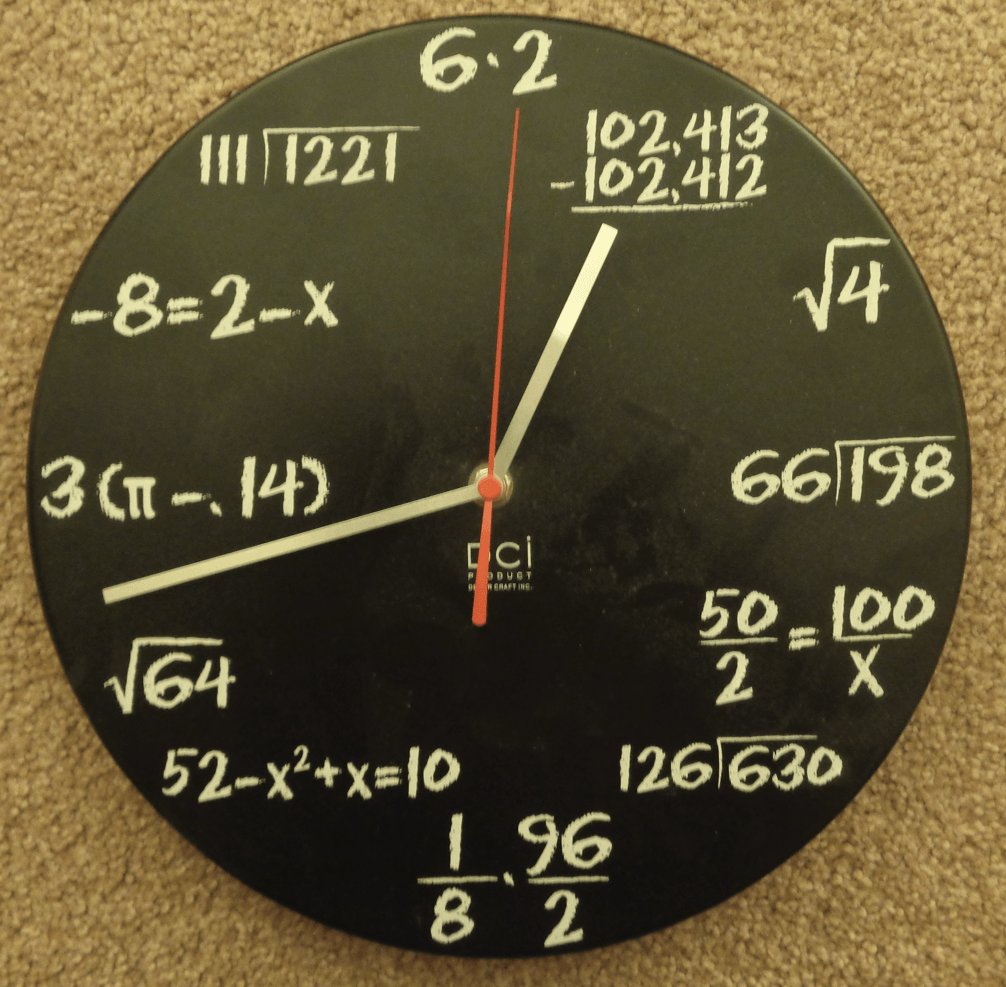
- Draw an equation clock in which each hour number is represented by an equation for which that hour number is a solution. E.g. ten o'clock below.
So I can...
- Translate between visuals and setup equations for balance problems of forms x+b=c, ax=c, ax+b=c, and all jumbled variations thereof, where all variables are non-negative integers and easy to visualize.
- Solve the balance problems with logic and guess-and-check.
- Check my work visually, symbolically, and with software.
- Show by example what the following words mean: equation, solution, non-solution, check.
As assessed by...
[coming soon]
Lesson 2: Solving ax+b=c by Preservation of Equality & Isolation
I will...
- Solve and Check Equations Visually - One Instance
- Solve equations symbolically.
So I can...
[coming soon]
As assessed by...
[coming soon]
Lesson 3: Solving ax+b=cx+d by Preservation of Equality & Isolation
I will...
- Solve Equations Visually with two instances of an unknown.
- Solve balance problems through isolation that I have to draw myself. Boxes & Circles, Levels 4, 5, and 6.
- Create my own solve and check problems with the Isolate then Check [template] .
- Practice solving equations symbolically to fluency.
So I can...
- Translate between visuals and equations for balance problems of forms ax+b=cx+d.
- Solve all equations of the form ax+b=cx+d and all jumbled variations.
- Create my own examples of linear equations to solve.
- Check my work visually, symbolically, and with software.
- Explain in my examples and exercises how doing the same thing to both sides preserves equality.
As assessed by...
[coming soon]
Lesson 4: Generalizing Preservation of Equality
I will...
-
See how well I understand preservation of equality in
- This Twitter thread [Focus on the 3 highest webs on the left.]
- JUMP 7.1 Scale Diagrams
- Practice with Dr Frost's materials on Unknowns on Both Sides .
- Drill solving more advanced equations. Solving & Checking Linear Equations (equations with more fractions coming soon!)
- Do JUMP 6 Solving Symbolically exercises. [to be moved to earlier lesson]
So I can...
- Describe all my previous visual solutions symbolically, including every step and check, using correct math terminology.
- Solve and check linear equations involving rational numbers using more than 1 method.
- Distinguish manipulations that do and do not preserve equality.
- Distinguish manipulations between the useful and the non-useful.
As assessed by...
[coming soon]
Lesson 5: Solving with Inverse Operations
I will...
- Solve the "Think of a Number" trick and be able to explain it to others. Create my own variations on the trick and perform them.
- Solve any previous equations from previous lessons using inverse operations.
So I can...
- Solve and check linear equations using inverse operations or the same manipulation to both sides.
- Show these methods' equivalence.
- Use both methods to solve magic tricks.
As assessed by...
[coming soon]
Lesson 6: Beyond Visuals
I will...
[coming soon]
So I can...
- Solve equations of the form ax + b = cx + d involving rational numbers and numbers that are difficult to visualize. I can solve them in multiple ways.
- "Look ahead" to determine when solutions exist and when they do not.
- Set up and solve equations in applied situations.
As assessed by...
[coming soon]
Course Outline
Essential Questions
- When is recursion a good way to think about relationships? When are 2-variable relationships a better way? What are the strengths and weaknesses of each method?
- How do mathematicians represent the concept of change? What about rate of change?
- What makes a relation linear? How do mathematicians represent that linearity?
- How did knowing the definition of "solution" and "equation" help us in this unit?
- How does math help make digital art?
- The most famous saying in statistics: "Correlation isn't causation." What does this mean? Why do we need statisticians to tell us this?
Lesson 1: Representing Recursion
I will...
- Begin learning the coordinate plane with pencil-and-paper drills.
- Do software activities on Desmos.
- Represent recursion in a variety of ways.
So I can...
- Use recursion in stories, tables, diagrams, and graphs to make predictions about linear relations.
- Translate among those representations fluently and explain in my own words how they model the same quantitative relationship.
- Name and use all components of the coordinate plane.
As assessed by...
[coming soon]
Lesson 2: Types of Recursion
I will...
[coming soon]
So I can...
- Recognize that “linear” means a constant rate of change and I can represent that in a variety of ways.
- Distinguish linear vs non-linear relations.
- Use a spreadsheet to create tables and visuals.
As assessed by...
[coming soon]
Lesson 3: Rates of Change
I will...
- Drill all kinds of Slope Exercises .
So I can...
- Determine rates of change from data with non-unit gaps.
- Interpret this in context and determine whether relations are linear or not.
- Recognize and represent a rate of change in a variety of ways.
- Parse any linear relation in terms of input variable, output variable, rate of change, and "initial" value.
As assessed by...
[coming soon]
Lesson 4: From Recursion to Relations
I will...
- Reverse engineer and perform generalization Magic Tricks .
-
Crack the code (formula) on some
VisualPatterns.org
.
- Beginner patterns: #4, 7, 14, 17, 18, 435
- Example
- Blank Template
-
Also make the leap from sequential/recursive thinking to explicit algebraic thinking with
- JUMP 8 Formulas, Tables, and Graphs
- Level 1 Example
- Level 1 Exercises
- Level 2 Exercises
- Level 2 Template . (Make your own!)
- Level 3 Exercises . Recompile to get new numbers.
- Generalizing Linear Patterns
-
Crack the code (formula) on even HARDER
VisualPatterns.org
.
- Intermediate: #12, 32, 436, 437
- Advanced: 265, 269
- What do you most need to remember from each level of difficulty?
- Can you tell which are linear and which are not?
- Solve equations using inverse operations.
- Optional: Reasoning with Lengths
So I can...
- Recognize situations in which recursion is tedious or inexact.
- View algebraic formulae as a generalized relationship, one that is verified when all the data are solutions. I know that the graph of an equation is the plot of the equation’s solutions.
- Understand letter variable as an abbreviation for a class of numbers rather than a fixed and known number.
As assessed by...
[coming soon]
Lesson 5: Graphs
I will...
- JUMP 7.1 Creating and Using Algebraic Expressions & Equations
- Linear Structure Recognition
- Linear Relations Word Problems, Part 1
- Linear Relations Word Problems, Parts 2 & 3
- Complete the Graphs and Equations exercises.
- Determine Equation from Line
- Desmos: Match My Line
- Desmos: Marbleslides - Lines
- Desmos: Marbeslides - Challenge
- Desmos: Land the Plane
- Tables to Equations
- From Equation to Parameters to Line (no tables)
- Visual Patterns: #435, 436, 437 (dots)
So I can...
- Translate between data, visuals, tables, equations, and graphs for all linear relations. I can explain in my own words how they all model the same logical relationship.
- Solve problems symbolically and graphically.
- Create art with points, lines, and restrictions in Desmos.
As assessed by...
[coming soon]
Lesson 6: Intro to Statistics
I will...
- Analyze the Sleep & Seizures case.
- Analyze the International COVID case numbers.
So I can...
- Sketch regression lines and estimate and interpret their equations.
- Generate multiple reasonable hypotheses for the relationship and propose ways to test (falsify) them.
- Generate practical examples of how correlation does not imply causation.
As assessed by...
[coming soon]
General
Polynomials - Quadratics
Polynomials - Cubic
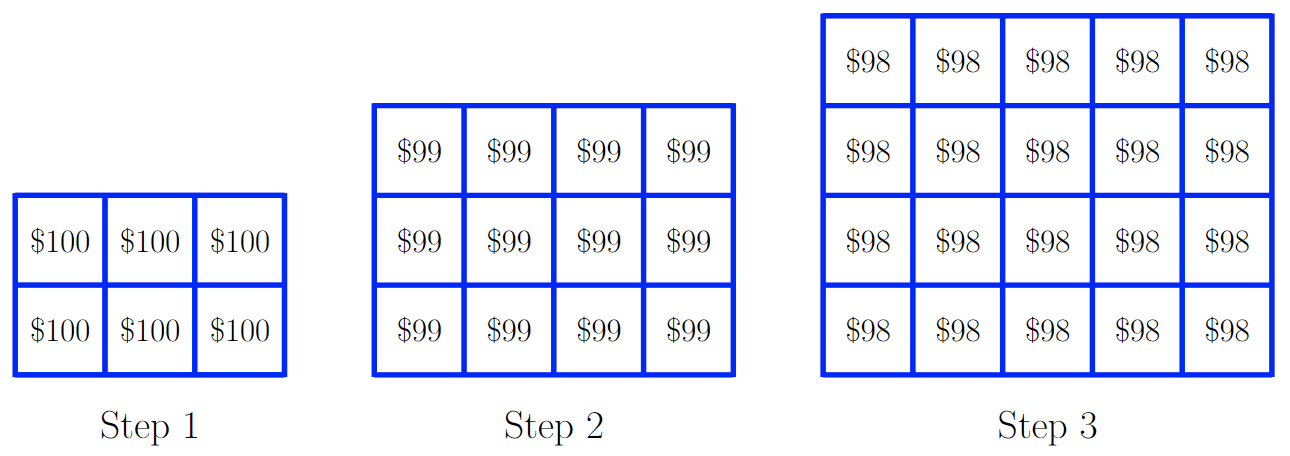
How much money in Step 43?
Exponential Functions - Basic
- The Smallpox Case
- Desmos: Carlos's Fish
- Compounding & Decay
- Exponential Notation
- Scientific Notation
Exponential Functions - Intermediate
Exponential Functions - Advanced
Rational Functions - Basic
-
Reciprocal Functions
- Reciprocals - Generalizing
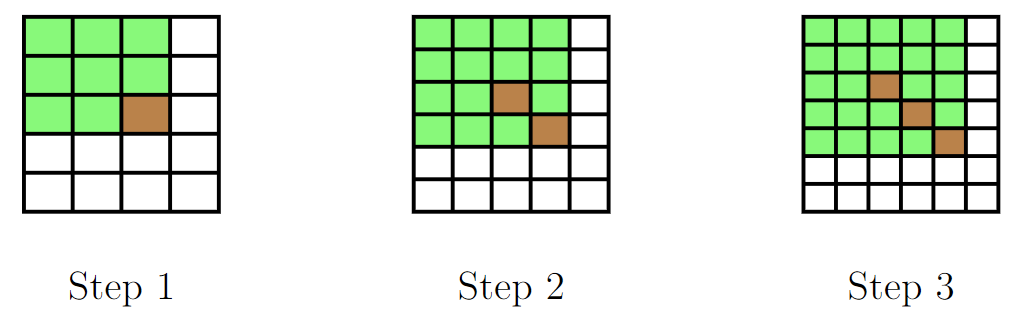
- Visual Pattern #268
-
Another visual pattern:
Rational Functions - Intermediate
Putting it All Together - Basic
Putting it All Together - Intermediate
-
Domain and Range
- Desmos: Shira the Sheep (variables and inequalities)
- Inequalities with Variables (worksheet)
- Desmos: Domain & Range
- Functions
- Clock of Nines
Putting it All Together - Advanced
-
Desmos Marbleslides: Challenge Set by Sean Sweeney
- Final Project: Medical Data, Part 2
Essential Questions
- What does "calculus" mean?
- Why can one not use high school math to answer the central questions of calculus? Can you explain with stories and/or examples?
- What is the relationship between a rate of change and the total amount of change? How many ways can we represent this relationship? What is the relationship called?
- What is the main reason introductory calculus students struggle? Hint ( source )
Whole Course Resources
-
Alternative Calculus Outline
- Note that this course will be doing Term 1's content only.
- Calculus Concept Inventory
- Satirical 10 Day Syllabus for Precalculus
Limits & Derivatives of Polynomials - Basic
Limits & Derivatives of Polynomials - Intermediate
Limits & Derivatives of Polynomials - Advanced
The Fundamental Theorem of Calculus - Basic
The Fundamental Theorem of Calculus - Intermediate
The Fundamental Theorem of Calculus - Advanced
vComing soon